
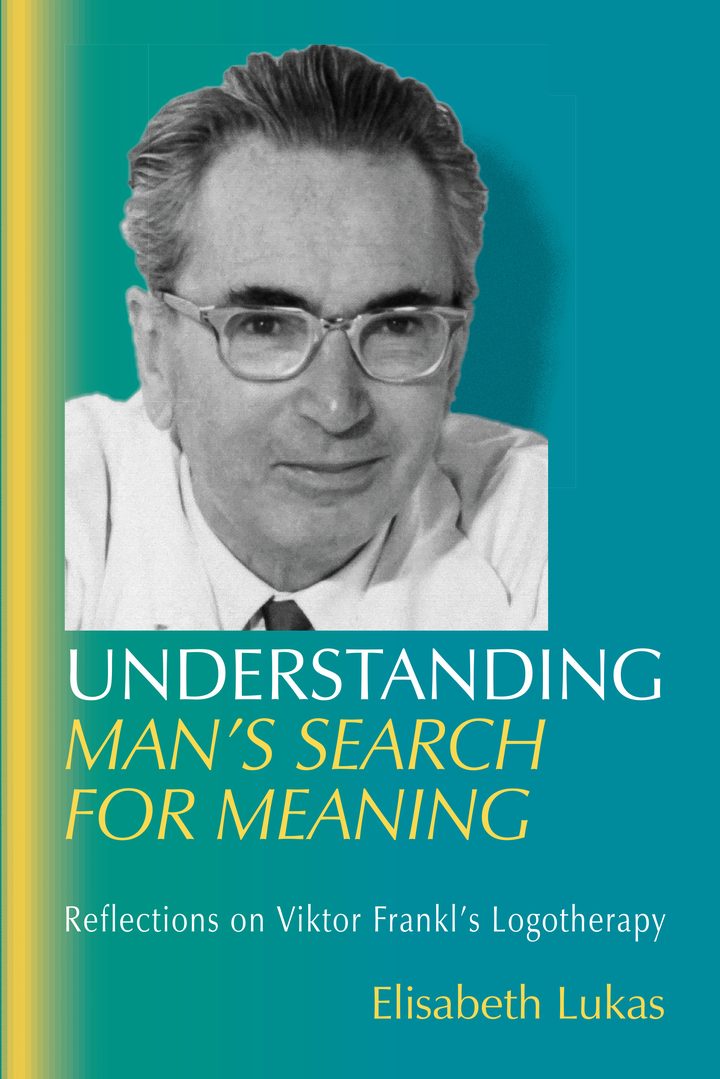
Understanding Man’s Search for Meaning
Reflections on Viktor Frankl’s Logotherapy
Elisabeth Lukas
Lukas illuminates principles of logotherapy
in keynote addresses and journal articles.
- Translated by Joseph Fabry, Howard Smith, Bianca Zwang-Hirsch, and James O’Meara
- Edited by Charles McLafferty, Jr.
Purpose Research may earn affiliate commissions from qualifying purchases.
About this book
In Man’s Search for Meaning, Viktor Frankl told the story of his experience in the Nazi concentration camps, and outlined the basis for finding meaning in life, which he called logotherapy. Elisabeth Lukas is one of Frankl’s foremost students, and has written numerous books and given lectures and training courses around the world.
This book contains a distillation of the writings of Elisabeth Lukas, based on decades of reflection on, and application of, the core ideas embodied in the logotherapy of Viktor Frankl. Available for the first time in English, this collection of articles and keynote addresses gives further insights into topics including:
- The role of meaning in finding health
- Moving beyond self-actualization toward self-transcendence
- How our view of past, present, and future can be healing: “noëtic temporality”
- The importance of “key words” in preventing the imposition of values
- How relapses can be reduced using the concepts of logotherapy
- Unique characteristics of logotherapy that distinguish it from other approaches
“Human beings do not automatically react; they respond, they show response-ability.”p. 48
From the book
The human being is motivated to live and to act not so much by having something to live on, but something to live for, a task to fulfill, an idea to realize, a goal to reach.p. 4
Following a tale in which two interpreters analyze a sultan’s dream in opposite ways, resulting in one being flogged and the other paid with gold, Lukas wrote:
The story contains two pieces of wisdom. For one, it tells of the dialectic of staying and passing. If I want to remain as the survivor in my family, I must accept the loss of my loved ones. If I do not want to lose my loved ones, I must depart this life before them. Staying is not possible without loss; staying has its price. And that can be generalized: It is only the transitoriness of life that makes life meaningful; only through death does the meaning of a human life remain in existence.…
Logotherapy is often nothing but the correction of a “how” in a patient’s viewpoint. The future will bring fifty lashes or fifty gold pieces. It will reward or punish the person for the views and attitudes chosen—attitudes to the same situations! For the attitude: “Why should I take care of my children? No one took care of me!” it will strike such an individual 20 years later when the great distance to his or her children causes great pain. For the attitude “I suffered as a child, so I want to spare my children that lot!” it will place something precious into that person’s hands 20 years later, when the children give warm greetings.p. 29
Why is there so much evil in the world? Why is there so much suffering everywhere? We don’t know. We don’t understand. Simply put, it is not for us to pose questions, it is not we who are to question life, as Viktor Frankl realized; on the contrary, it is our task to give answers to the questions posed to us by fate. Sickness, distress, suffering, and danger are the question marks of our lives, not necessarily written by us, but to be answered by us in our own handwriting in our response to life. Everything we do or fail to do is an answer to the questions of fate.…
Human beings do not automatically react, they respond, they show response-ability. And the more our answers are oriented toward a meaning, the more they liberate us from the power of an incomprehensible fate.p. 48
On Elisabeth Lukas
For Lukas, there is no human being who does not retain a chance to grow, no situation which does not have its spark of meaning.… To elucidate meaning possibilities is the art of Elisabeth Lukas and entirely in the tradition of logotherapy.
Viktor E. Frankl, M.D., Ph.D.
[Dr. Lukas is] a compassionate logotherapist who understands that the personal/spiritual dimension of a given client has to be considered in order to give hope, purpose, and meaning to the windstorms of life.
Elisabeth Kübler-Ross, M.D.Author of On Death and Dying
Contents
- 1The Logotherapeutic View of Human Nature1
- 2Logotherapy: Health Through Meaning7
- 3What is Special About Logotherapy?21
- 4Survival—To What End? Answers to Questions of Fate37
- 5Waiting for Godot? The Logotherapeutic Alternative51
- 6From Self-Actualization to Global Responsibility71
- 7Correcting the Image89
- 8On Overcoming the Tragic Triad: Suffering, Guilt, and Death95
- 9“Key words” as a Guarantee Against the Imposition of Values107
- 10A Person’s Admission Into Self-Responsibility: Reducing the Relapse Rate in Psychotherapy117
- 11Reflections on our Future (2014)135
More by Elisabeth Lukas
Meaningful Living
Elisabeth Lukas2020
Meaning in Suffering
Elisabeth Lukas2014
The Therapist and the Soul
Elisabeth Lukas2015
Stillness and Concentration
Elisabeth Lukas2020
A Unique Approach to Family Counseling
Elisabeth Lukas2020