
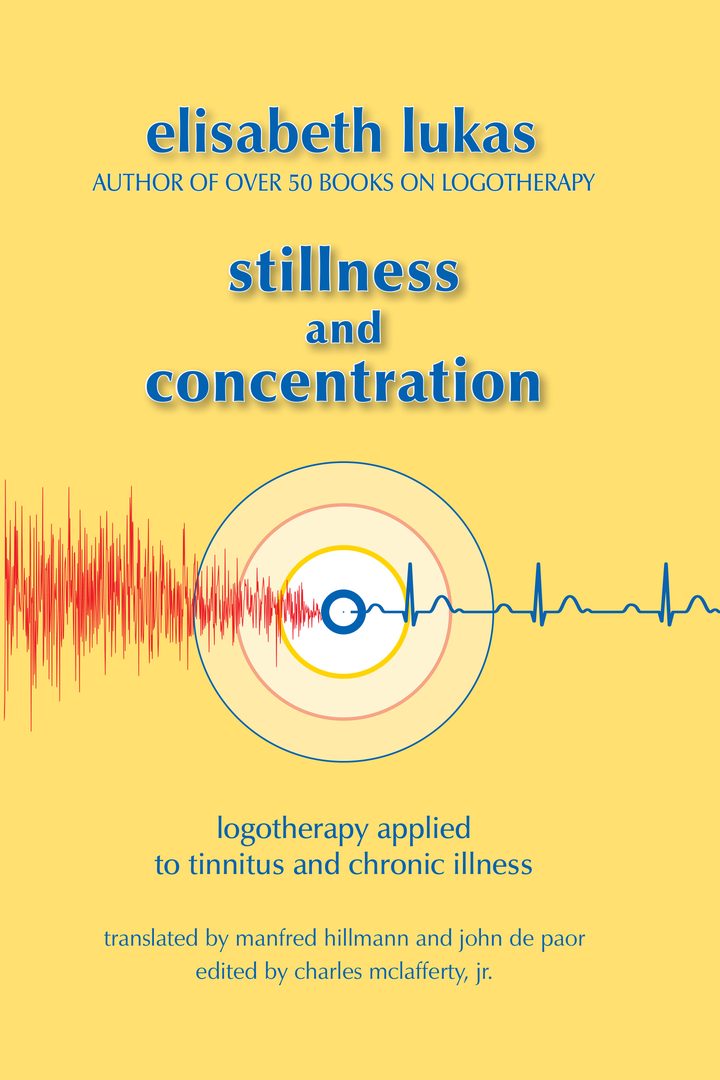
Stillness and Concentration
Logotherapy Applied to Tinnitus and Chronic Illness
Elisabeth Lukas
Living fully with a chronic condition,
using tinnitus as an example.
- Translated by Manfred Hillmann and John de Paor
- Edited by Charles McLafferty, Jr.
Purpose Research may earn affiliate commissions from qualifying purchases.
About this book
Many people suffer from chronic conditions that affect their daily functioning. Each day they awaken to new challenges. In this book, Elisabeth Lukas presents a series of vignettes and stories interwoven with the concepts of meaning-centered living that help the individual deal with unavoidable suffering.
Chronic illnesses exact a toll—the symptoms are ever-present and whittle away at the individual’s life energy and experience. Tinnitus is an example of an ongoing series of symptoms that can create havoc in a person’s inner life. In this book, Lukas uses tinnitus as an example of a chronic illness that can be addressed by finding an inner point of stillness and concentration.
This volume contains the original text of Stillness and Concentration followed by an article on meaning and goals for those with chronic illness. Additional chapters address a psychotherapy with dignity, one that preserves our inherent freedom.
- First published in German as Konzentration und Stille. Logotherapie bei Tinnitus und chronischen Krankheiten, Verlag Profil, München, in three editions between 2000 and 2005.
“You will have to acquire new hearing, not that of physical ears, but rather of the heart’s ears.”p. 5
From the book
I will never forget the day, at a conference in Kansas City (Missouri, USA) when I was asked to demonstrate a therapeutic dialogue. Full of good spirits, I readied myself to do so. When the patient was finally brought into the room I found that she had only a few weeks to live, because she was suffering from throat cancer which was progressively blocking her breathing. In fact, for this very reason, she had to have an oxygen cylinder always at hand. My optimism soon vanished and gave way to a feeling of helplessness. What possible comfort could I give to this woman?
After mutual greetings, we sat together in silence for a few moments. During this time, while I was in a state of bewilderment, this credo came back to me, one that has so blessedly accompanied me throughout the decades of my professional work: Every human life is permeated with meaning, literally to its last breath! Like a wave out of an agitated sea it welled up from out of my reflections and feelings and gave me strength. I looked into the face of this doomed woman and began our conversation. […]
At this point, something suggested itself to my lips: “Did you say that, until now, none of your children or grandchildren was ever seriously ill? And that no major accident had ever happened in your family?” […]
“Suppose then that you could choose which one of the family it had to be who would fall ill in this way, which one would you choose? […]”
“Heaven forbid!” shouted the woman, with some of her former energy vibrating in her voice. She drew her upper body up to its full height. “No,” she explained firmly, and as she spoke she seemed in a strange way to gain in strength, “if one of us were to get ill, if one of us has to be the first to go, then I would like it to be me.”
“So then, if the choice had been yours….”
She would not allow me to finish speaking. She affirmed with total certainty: “If the choice had been mine I would have chosen what fate has chosen for us.” Thereupon, the whole group assisting at the conference broke into spontaneous applause. It was marvelous. Everyone present witnessed how a human being under mortal threat could say “yes” to fate.pp. 69–71
On Elisabeth Lukas
For Lukas, there is no human being who does not retain a chance to grow, no situation which does not have its spark of meaning.… To elucidate meaning possibilities is the art of Elisabeth Lukas and entirely in the tradition of logotherapy.
Viktor E. Frankl, M.D., Ph.D.
[Dr. Lukas is] a compassionate logotherapist who understands that the personal/spiritual dimension of a given client has to be considered in order to give hope, purpose, and meaning to the windstorms of life.
Elisabeth Kübler-Ross, M.D.Author of On Death and Dying
Contents
- —Introduction: Listening to Silence3
Part A. Stillness and Concentration: Logotherapy Applied to Tinnitus and Chronic Illness
- 1A Fulfilled Life Despite Pain?7
- 2No One is Superfluous or Replaceable9
- 3Something Important Awaits Each Person13
- 4Yes, Wonders Do Still Happen!17
- 5Mind and Body Working Together21
- 6How to Let Go of Fears25
- 7Cheerfulness as a Philosophy of Life29
- 8How Can Anything Become Good Again?33
- 9Power and Responsibility37
- 10Self-Conquest out of Love41
- 11Uselessness—Apparent or Real?45
- 12Sending Them Back to the Deep49
- 13Sending Them Ahead to the Waiting Room53
- 14Time Brings Many Surprises57
- 15The “Aha!” Experience of Seeing Things From the Other Side61
- 16The House With the Golden Windows65
- 17A Question to Think About69
- 18Keeping One’s Eyes on the Lighthouse of Meaning73
Part B. Reflections on a Psychotherapy With Dignity
- 19Meaning and Goals in Life for People With Chronic Illness79
- 20The “Birthmarks” of Paradoxical Intention93
- 21A Validation of Logotherapy101
- 22Counseling Tactics and Personality Structure113
- 23Logotherapy on Hysteria137
- 24Logotherapy in the Practice of Clinical Psychology145
More by Elisabeth Lukas
Meaningful Living
Elisabeth Lukas2020
Understanding Man’s Search for Meaning
Elisabeth Lukas2020
Meaning in Suffering
Elisabeth Lukas2014
The Therapist and the Soul
Elisabeth Lukas2015

A Unique Approach to Family Counseling
Elisabeth Lukas2020