
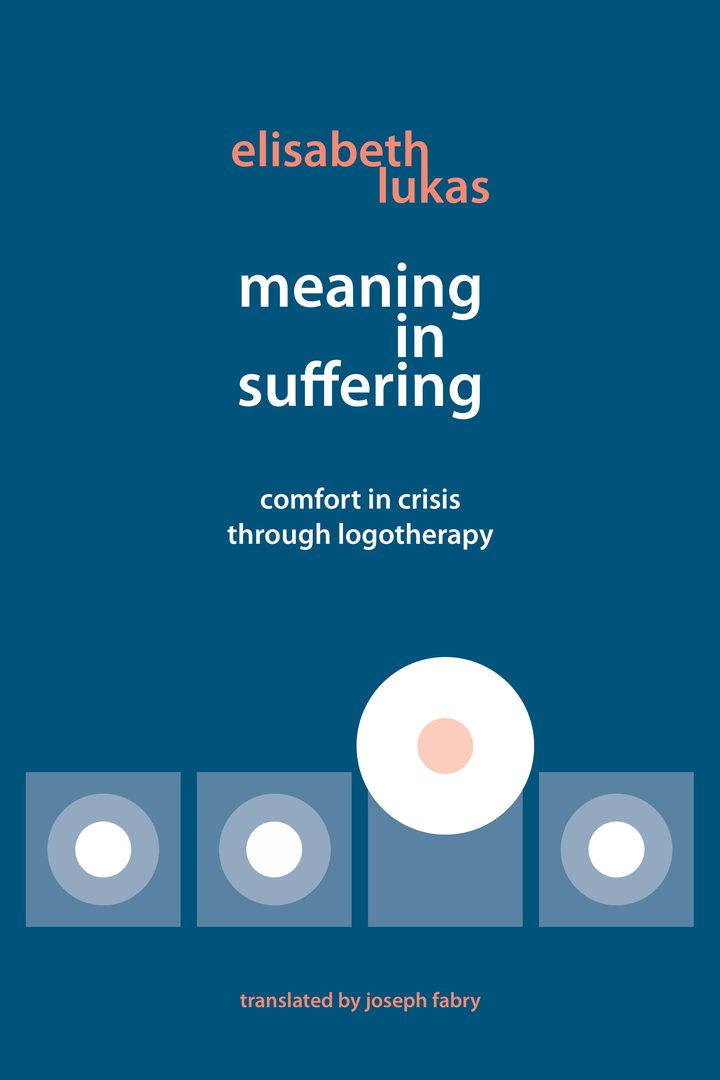
Meaning in Suffering
Comfort in Crisis Through Logotherapy
Elisabeth Lukas
Comfort where no cure is possible,
across dozens of case studies.
- Foreword by Muriel James, Ed.D., author of Born to Win
- Translated by Joseph Fabry
- Second edition
Purpose Research may earn affiliate commissions from qualifying purchases.
About this book
Elisabeth Lukas’ artistic discovery of the uniqueness of each individual shines across dozens of case studies and examples; thus she illuminates the potential for meaning in the presence of even intractable pain, guilt, and suffering. Lukas demonstrates a living logotherapy, not by standardized techniques, but by the compassion and insight she brings into each therapeutic relationship.
“The true heroes of life are not the triumphant victors, but the defeated who find a ray of hope.”p. 52
From the book
For thousands of years, people have done pretty well without the science of psychotherapy. Yet, something like psychotherapy has always existed—through persons who, with charisma, persuasiveness, and force of conviction, were able to bring comfort to those looking for help. Such help was usually based on a specific philosophy of life.
The afflicted were promised eternal well-being and justice in the hereafter, their suffering was presented as a test on their way to happiness, or philosophical–ethical images were invoked to make blows of fate bearable. Psychotherapy was religion and vice versa.
This embeddedness in mysticism made it difficult for psychotherapy to find a scientific approach. Today, if we try to find rational explanations for irrational behavior and offer rational help for irrational psychological problems, we stand on a narrow ridge between two abysses: On the one side lies the danger of reverting to mysticism; on the other, slipping into a mechanized manipulation of the human person.
Has psychology, on its long development through magic, exorcism, trickery, and fanaticism, finally attained the status of science? In recent decades, great strides have been made in that direction. Successes were conspicuous and resulted in a great variety of tools in a giant psychological workshop to serve people, but unfortunately the specifically human dimension—the spirit—was left out. “Psychotherapy without magic” has been replaced by “psychotherapy without spirit.” What was gained in the field of science was lost from humanity. Psychotherapists may choose from a great number of methods, but are forced to walk on that narrow ridge between old views and new perspectives, between speculative interpretations and human programming. It is a path illuminated by alarmingly few firm criteria.…
This book suggests a path for both lay reader and professional, a path through the maze of psychological schools to a psychotherapy that no longer is a myth. To do so, it must include the human spirit, combine science and humanity; in so doing, it can justify our trust, especially the trust of the suffering person. The value of a psychotherapy is tested by what it can do for those who suffer. Where help is no longer possible, comfort must be given; where no comfort is possible, any psychotherapy is useless.pp. 1–2
The human spirit, by definition, is the dimension of human freedom and therefore not subject to deterministic laws. Freedom is a word often misused. To avoid misunderstandings, Frankl did not speak of freedom from something, especially not from conditions (no one is free from his or her physical and psychological conditions). Frankl spoke of freedom to something—a freely taken attitude toward these conditions.p. 7
Many problems can be alleviated by directing the patients’ attention to areas of freedom, where they still have the opportunity to come to terms with fate, to direct attention away from unchangeable situations and their possible causes or consequences.p. 7
I often get requests for logotherapeutic techniques. I myself wished for a methodology when I started to use logotherapy. Now I know that a standardized guide would be more hindrance than help. Every patient is different, none can be classified; even symptoms are clearly systematized only in textbooks.
Logotherapy is more than a method. It is a healthy way of living that can be used in therapy if it is actually lived: first by the therapist, then—with the help of the therapist—by the patient. Which means: If you don’t live logotherapy, you cannot use it in healing.
Living the principles of logotherapy means offering part of yourself so a part of another person can live a healthier life.p. 129
Endorsements
For Lukas, there is no human being who does not retain a chance to grow, no situation which does not have its spark of meaning.… To elucidate meaning possibilities is the art of Elisabeth Lukas and entirely in the tradition of logotherapy.
Viktor E. Frankl, M.D., Ph.D.
An easily understandable comparison of former and mostly outdated forms of therapy emphasizing the blessings of a compassionate logotherapist who understands that the personal/spiritual dimension of a given client has to be considered in order to give hope, purpose, and meaning to their windstorms of life.
Elisabeth Kübler-Ross, M.D.Author of On Death and Dying
In her clear, down-to-earth style, Elisabeth Lukas offers case studies out of her practice to illustrate how logotherapy deals with problems of suffering, both undeserved and deserved, and with guilt, both neurotic and appropriate. In doing so, she demonstrates how logotherapy is concerned with the most human dimension of personality.
Robert C. Leslie, Ph.D.Author of Jesus and Logotherapy
Contents
- Foreword by Muriel James
- 1Comfort Where No Cure Is Possible1
- 2The Best Possible Help21
- 3Suffering and the Question of Meaning45
- 4Guilt and the Question of Meaning63
- 5Resistance in Suffering77
- 6The Will to Joy as a Health Resource87
- 7Psychotherapy and Responsibility101
- 8Reflections117
- Conclusion129
More by Elisabeth Lukas
Meaningful Living
Elisabeth Lukas2020
Understanding Man’s Search for Meaning
Elisabeth Lukas2020
The Therapist and the Soul
Elisabeth Lukas2015
Stillness and Concentration
Elisabeth Lukas2020
A Unique Approach to Family Counseling
Elisabeth Lukas2020