
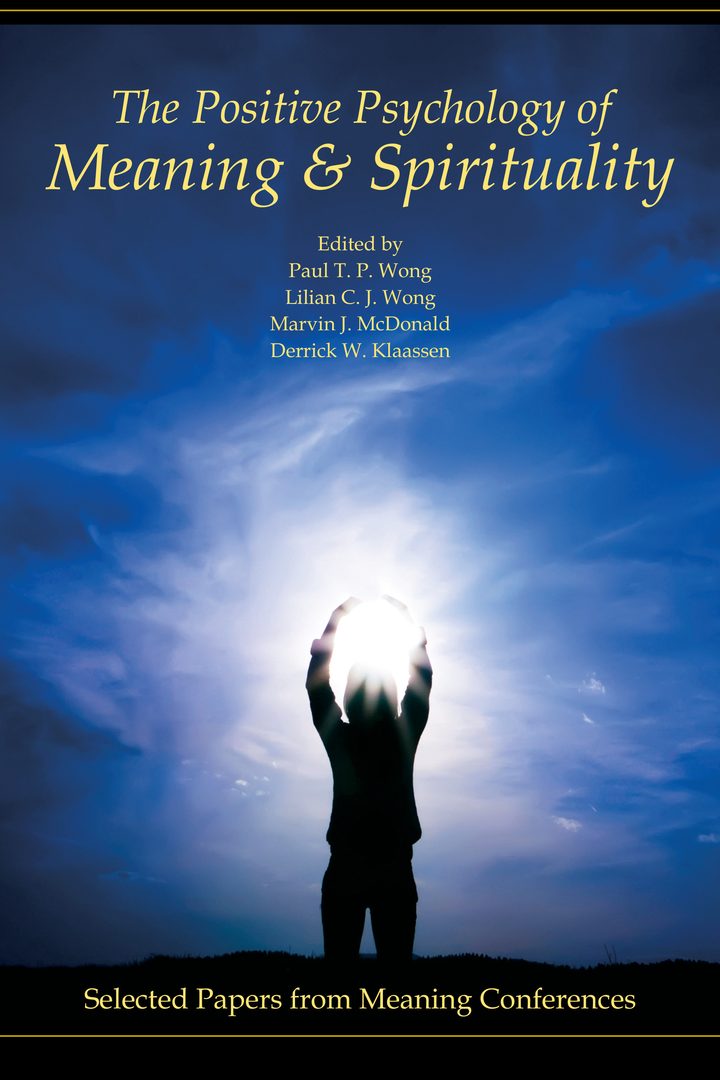
The Positive Psychology of Meaning and Spirituality
Selected Papers from Meaning Conferences
Paul Wong, Lilian Wong, Marvin McDonald, and Derrick Klaassen (Eds.)
Luminaries offer insights
into meaning and spirituality
in well-being and suffering.
- Purpose Research edition; originally published by INPM Press.
Purpose Research may earn affiliate commissions from qualifying purchases.
The volume
Papers and presentations from conferences held by the International Network on Personal Meaning. Articles are included from luminaries such as Howard Gardner, Harold Koenig, Sal Maddi, Donald Meichenbaum, Crystal Park, Jordan Peterson, Alfried Längle, Ernesto Spinelli, Paul Wong, Kirk Schneider, and Bernard Weiner. This volume contains a number of must-read essays on topics from suffering, death, and grieving to meaning, spirituality, and virtues.
“Courage is not the absence of fear, but the capacity to carry on in spite of it.”Paul Wong, p. 254
From the book
Howard Gardner, from “Good Work: Where Excellence and Ethics Meet”:
So, how do we think about good work? Good work happens when an individual working in a profession is able to be highly skilled in that profession yet also is able to have a perennial concern of the implications of what he or she does. Nobody always does the right thing. Nobody always knows the implications of his or her work. But there is a big difference between people who think about the implications of their work all the time and try to do the right thing, and people who are indifferent to that whole set of concerns.p. 342
Paul Wong, from “The Positive Psychology of Suffering and Tragic Optimism”:
What do we say to those whose lives have been devastated, and to those who have struggled with their gaping wounds?… What do we say to the thousands who die of AIDS and poverty each day in Africa? The gospel of happiness and success sounds hollow to those who are struggling daily to survive in a living hell; they can neither control nor understand the negative forces that are destroying their lives.p. 238
Alan Pope, from “Existential Implications of Becoming an Orphan at Midlife”:
Perhaps the most significant benefit to maintaining [a] relationship to the deceased parent derives from the way that bereaved middle-aged children use their imaginations to continue learning from the parent.… At one level, surviving adult children perform a life review that enables them to situate the parent’s life within a larger context through which they are better able to understand the parent and heal old grievances. They come to forgive their parents for those actions and/or characteristics they had formerly disapproved of or resented.… In addition, in reviewing the parent’s life, bereaved adult children naturally review their own lives, perhaps finding that they regret—with feelings of guilt and/or shame—aspects of how they related to their parent. They come to realize that there were things about the parent they took for granted.p. 144
From the collection
Positive evolution is about correcting what is wrong as much as creating what is right. We need to ask: How can we bring out the best in people in spite of their limitations and weaknesses? How can we make the best of the worst situations?
Paul WongTyndale University College
Things that are bitter, feared and avoided must be approached and conquered, or life finds itself increasingly restricted, miserable and hateful. Our greatest stories therefore portray the admirable individual, engaged in voluntary, creative, communicative endeavor; they portray that individual generating a personality capable of withstanding the fragility of being, from such endeavor.
Jordan B. PetersonUniversity of Toronto
Sometimes the world seems a very bleak place indeed whether because of personal circumstances or those of the more international variety. It is in those moments, I believe, that our willingness to embrace our human existence is truly tested and we are confronted with the full brunt of our own, and the world’s imperfection.
Ernesto SpinelliRegent’s College, London
Contents
- Acknowledgements
- Preface
- About the Editors
- About the Contributors
- —Introduction: A Quiet Positive RevolutionPaul Wong
Part One: Meaning, Spirituality, & Religiosity
- 1The Meaning of MeaningJordan B. Peterson
- 2The Phenomenon of Meaning: How Psychology Can Make Sense of ItDmitry A. Leontiev
- 3The Search for Meaning in Life and the Existential Fundamental MotivationsAlfried Längle
- 4Meaning, Hermeneutics, and Ethics: Post-postmodern SubjectivityJens Zimmermann
- 5The Role of Hardiness and Religiosity in Depression and AngerSalvatore R. Maddi
- 6The Existential Roots of Mindfulness MeditationSameet Kumar
- 7Approaches to Deepening Personal MeaningAdam Blatner
Part Two: Existential, Religious, & Narrative Therapies
- 8Hell Is Other People: A Sartrean View of Conflict ResolutionErnesto Spinelli
- 9What “Expert” Therapists Do: A Constructive Narrative PerspectiveDonald Meichenbaum
- 10Religious Discourse in PsychotherapyAlvin C. Dueck and Kevin Reimer
- 11Existential Implications of Becoming an Orphan at MidlifeAlan Pope
- 12Meaning Making in Illness: A Potent Human MagicMaureen Angen
- 13Posttraumatic Growth: Finding Meaning Through TraumaPatricia Frazier, Amy Conlon, Ty Tashiro, and Sarah Sass
- 14Influences of Global Meaning on Appraising and Coping with a Stressful EncounterCrystal L. Park
- 15Meaning in Life and Resilience to Suicidal Thoughts Among Older AdultsMarnin J. Heisel and Gordon L. Flett
- 16Finding Meaning in Chronic Pain: The Dynamics of AcceptanceEarl D. Bland and Douglas D. Henning
Part Three: Suffering, Death & Grieving
- 17Spirituality and Pain: Finding Purpose, Meaning, and Hope in the Midst of SufferingHarold Koenig
- 18Suffering, An Existential Challenge: Understanding, Dealing, and Coping with Suffering from an Existential-Analytic PerspectiveAlfried Längle
- 19The Positive Psychology of Suffering and Tragic OptimismPaul Wong
- 20Wisdom, Religiosity, Purpose in Life, and Attitudes Toward DeathMonika Ardelt
- 21A Death is Worth a Thousand Tellings: Transformation Through StorytellingJanette E. McDonald
- 22The Case of “Paula”: An Existentially Based Treatment Approach to Chronic DepressionJoanna Lipari
- 23Swallowed Alive by the Grief Beast: An Autobiographics of HealingTara Hyland-Russell
- 24Hardiness in Bereaved Parents Following Fetal or Infant DeathAriella N. Lang and Lynne M. MacLean
- 25Mythological Perspectives on the Journey of DeathWilliam E. Smythe
- 26Paradigm Shifting: Transforming Catastrophic EventsMarla J. Colvin
Part Four: Positive Psychology of Good Work and Other Virtues
- 27Good Work: Where Excellence and Ethics MeetHoward Gardner
- 28Spirituality, Meaning, and Good WorkPaul Wong
- 29A Transformative Approach to Compassionate and Spiritual CarePaul Wong
- 30The Fluid Center: An Awe-Based Challenge to CultureKirk J. Schneider
- 31Developmental Functions of Deferred EmpathyChristine V. Bruun and Belinda M. Wholeben
- 32On Responsibility Inferences and the Perceived Moral PersonBernard Weiner
Contributors
Editors 4 editors
- Paul T. P. Wong, Ph.D. received his Ph.D. in Psychology at the University of Toronto. At present, he is Professor of Psychology and Chair, Division of Social Sciences and Business Administration, Tyndale University College, Toronto. He has held professorial positions at the University of Texas at Austin, York University, Trent University, and the University of Toronto. He was the founding director of the Graduate Program in Counselling Psychology at Trinity Western University, BC. He is the founding President of the International Network on Personal Meaning (www.meaning.ca), the International Society for Existential Psychology and Psychotherapy (www.existentialpsychology.org) and the Meaning-Centered Counselling Institute. He is a Fellow of the American Psychological Association and Canadian Psychological Association. With more than 120 published articles and book chapters, his current interests cover several areas, from coping with stress to the positive psychology of meaning. Recently he has contributed three chapters to the Encyclopedia of Positive Psychology. The second edition of his edited volume, The Human Quest for Meaning, was published in 2012.
- Lilian C. J. Wong, Ph.D. is Associate Professor of Psychology, Tyndale University College, Toronto. She received her Ph.D. in Counselling Psychology at the University of British Columbia. Her primary research area is multicultural clinical supervision. Her Multicultural Supervision Competencies Questionnaire (developed with Paul Wong) has contributed to the conceptualization and measurement of multicultural supervision competencies. For many years, she has taken an active part in the Round Table Discussions on Hot Topics in Clinical Supervision and Training at APA conventions. Her other research interests include play therapy and grieving in children. She was on the Education Committee of the BC Association for Play Therapy for three years. She is on the Board of the International Network on Personal Meaning (www.meaning.ca) and Vice-President of the Meaning-Centered Counselling Institute. She is co-editor of the Handbook of Multicultural Perspectives on Stress and Coping (Springer).
- Marvin J. McDonald, Ph.D. is Director of the MA program in Counselling Psychology at Trinity Western University, BC. He is married to Darlys Carlson McDonald and joins her in parenting their two sons, Nathan and Christopher. He publishes in the areas of theoretical psychology, spirituality and health, and professional issues in counselling. He is co-author, with D. W. Klaassen & M. D. Graham, of “Constructivist stances for promoting justice in spirituality research,” in J. Raskin & S. Bridges (Eds.), Studies in Meaning 2: Bridging the Personal and Social in Constructivist Psychology (pp. 239–263). His more recent publications include “Negotiating justice in psychology: Situating psychology among rival moral orders,” in W. Smythe & A. Baydala (Eds.), Studies of How the Mind Publicly Enfolds into Being. He is involved with the International Network on Personal Meaning, (www.meaning.ca), and participates in interfaith dialogue activities in his community.
- Derrick W. Klaassen, MA, CCC is currently a Ph.D. student in Counselling Psychology at the University of British Columbia. He is a member of the Canadian Counselling Association and the Austrian Society for Logotherapy and Existential Analysis. His clinical and research interests include existential psychology and psychotherapy, cultural psychology, and the role of spirituality and religion in mental health.
Contributors 36 contributors
- Maureen Angen, Ph.D. is a chartered psychologist and a Canadian Institute of Health Postdoctoral Fellow with the Department of Psychosocial Resources at the Tom Baker Cancer Centre in Calgary, Alberta. She received a Ph.D. in Counselling Psychology from the University of Calgary, Alberta.
- Monika Ardelt, Ph.D. is Associate Professor of Sociology and a Founding Faculty Member of the Center for Spirituality and Health at the University of Florida. She received a Ph.D. in Sociology from the University of North Carolina, Chapel Hill. In 1999, Dr. Ardelt was elected as a Brookdale National Fellow to study the similarities and differences between aging and dying well.
- Earl D. Bland, Psy.D. is Associate Professor of Psychology, Chair of the Division of Behavioral Sciences and head of the Psychology Department at MidAmerica Nazarene University, also a part-time Director of Counseling & Mentoring at Olathe Bible Church. Dr. Bland received a Psy.D. from the Illinois School of Professional Psychology. He is a licensed psychologist in both Kansas and Missouri.
- Adam Blatner, M.D. received his M.D. from the Medical School at the University of California, San Francisco. From 1987–1994, Dr. Blatner was on the faculty of Psychiatry & Behavioral Science, School of Medicine, the University of Louisville, KY. He has also worked in hospitals, clinics, and private practice. He is one of the executive editors of ReVision: A Journal of Consciousness and Transformation and co-editor of an anthology on improvisational and interactive drama. He has authored several books, including Foundation of Psychodrama, and Art of Play: Helping Adults Reclaim Imagination and Spontaneity.
- Christine V. Bruun, Ph.D. is Professor of Psychology and Chair of the Department of Psychology at the Rockford College, Rockford, IL. She is interested in developing faith and trust in a college setting.
- Marla J. Colvin received her M.A. in Psychology from the University of Illinois. She is on the faculty of the Cuyahoga Community College, teaching courses in Psychology. Her interests include cross-cultural approaches to diagnosis and treatment, development and levels of consciousness, transpersonal psychology, and environmental psychology.
- Amy Conlon holds a B.S. in finance from the University of Wisconsin-LaCrosse (WI). She is the Senior Director of Retention Solutions, providing services to campuses through the use of the predictive model for student retention tool RetentionRT.
- Alvin C. Dueck, Ph.D. a licensed psychologist, is the Evelyn and Frank Freed Professor of the Integration of Psychology and Theology, Department of Clinical Psychology at Fuller Theological Seminary. He received a Ph.D. in Psychology/Education from Stanford University. His scholarly research interests are on the role of religion in therapy, congregational health, and conflict resolution between Christians and Muslims.
- Gordon L. Flett, Ph.D. is Professor of Psychology in the Department of Psychology, York University, Toronto, where he holds a Canada Research Chair in Personality and Health. He received a Ph.D. from the University of Toronto. Dr. Flett’s research interests include the role of personality factors and depression.
- Patricia Frazier, Ph.D. is Associate Professor in Counseling Psychology and Social Psychology in the Department of Psychology at the University of Minnesota, Twin Cities. She received a Ph.D. in Psychology from the University of Minnesota. Dr. Frazier has done extensive research on sexual assault and other traumatic life events. Her research interests include the effects of traumatic events, their potential to create positive life change, and on meaning in life.
- Howard Gardner, Ph.D. is the Hobbs Professor of Cognition and Education at the Harvard Graduate School of Education. He received a Ph.D. in Social Psychology/Developmental Psychology from Harvard University. He has authored many books, including, Frames of Mind, and Good Work. He is best known in educational circles for his theory of multiple intelligences. Most recently, Gardner and his colleagues have launched the GoodWork Project. “GoodWork” is both excellent in quality and exhibits a sense of responsibility with respect to implications and applications.
- Marnin J. Heisel, Ph.D. is Senior Instructor in Psychiatry at the University of Rochester Medical School. He received a Ph.D. in Clinical Psychology from York University, and completed a postdoctoral fellowship at St. Michael’s Hospital, University of Toronto. With Professor Gordon Flett, Dr. Heisel developed the Geriatric Suicide Ideation Scale (GSIS), an assessment tool for suicidal thoughts among seniors. His research interests include the role of character pathology in suicidality, and end-of-life issues.
- Douglas D. Henning, Ph.D. is the Undergraduate Associate Academic Dean and Professor of Psychology at MidAmerica Nazarene University in Olathe, Kansas, and a psychologist at The Rehabilitation Institute of Kansas City. He is a Diplomate in the American Academy of Pain Management. He received a Ph.D. in Counseling & Family Life, Oregon State University. With extensive clinical experience, Dr. Henning has taught in Switzerland, and instructed trainers in marriage and family in Moscow, Russia.
- Tara Hyland-Russell, Ph.D. is an Assistant Professor, St. Mary’s University College, Calgary, Alberta, and received her doctorate from the University of Calgary. Her research interests include twentieth-century literature, poetry and poetics, women’s life writing, critical theory, narrative discourse, children’s literature, folk and fairy tales.
- Harold G. Koenig, M.D., MHSc. is Associate Professor of Medicine and Psychiatry at Duke University Medical Center. He received a M.D. and M.H.Sc. from the University of California, San Francisco, and completed a fellowship in Geropsychiatry at Duke University Medical Center. He is the director and founder of the Center for the Study of Religion/Spirituality and Health at that institution. He has published extensively in the fields of mental health, geriatrics, and religion. He is editor of the International Journal of Psychiatry in Medicine, and founder and editor-in-chief of Research News & Opportunities in Science and Theology.
- Sameet Kumar, Ph.D. is a Buddhist psychologist trained with Tibetan Buddhist teachers. He received a Ph.D. from the University of Miami. Dr. Kumar works at the Mount Sinai Comprehensive Cancer Center in Miami Beach and Aventura, FL. His areas of expertise are in palliative care, spirituality in psychotherapy, stress management and relaxation, and grief and bereavement. He integrates mindfulness and spirituality in psychotherapy. He is the author of Grieving Mindfully: A Compassionate and Spiritual Guide to Coping with Loss.
- Ariella N. Lang, RN, Ph.D. is a Canadian Institutes of Health Research postdoctoral fellow in the School of Nursing at the University of Ottawa. Her career has centered around the improvement of care to grieving individuals and their families following the death of a loved one.
- Alfried Längle, M.D., Ph.D. is the founder and president (since 1983) of the Society for Logotherapy and Existential Analysis (Vienna). Dr. Längle studied medicine and psychology at the Universities of Innsbruck, Rome, Toulouse and Vienna. After years of hospital work in general medicine and psychiatry, he started a private practice in psychotherapy, general medicine and clinical psychology in Vienna.
- Dmitri A. Leontiev, Ph.D., Dr.Sc. is Professor of Psychology at Moscow State University, Russia. He is the Director of the Institute of Existential Psychology and Life Enhancement (EXPLIEN), Moscow, Russia, and Vice-President of Moscow branch of Russian Psychological Society. He is a member of the Board of Directors of ISEPP, editorial board of IJEPP and winner of the Promotional Award of Viktor Frankl Foundation, Vienna (2004).
- Joanna Lipari, Psy.D. received her doctorate from Pepperdine University, CA. She has specialized in existential psychotherapy and Geriatric Psychology at the Center for Healthy Aging in Santa Monica, CA. She has held research and clinical positions with the US Veterans at the West Los Angeles Administration. Dr. Lipari also works with adolescents who suffer from severe mental difficulties.
- Salvatore R. Maddi, Ph.D. is Professor in the Department of Psychology and Social Behavior at the School of Social Ecology, University of California, Irvine. He received a Ph.D. in Clinical Psychology from Harvard University. Dr. Maddi is a certified clinical psychologist. He specializes in personality, psychopathology, health psychology and creativity, and stress management. He is well known for his research and promotion of hardiness through deepening the attitudes of commitment, control, and challenge to reach individual potentials and cope with stress.
- Janette E. McDonald, Ph.D. received her doctorate in Human and Organizational Systems from the Fielding Institute in Santa Barbara, CA. She is an associate professor in the Adult Degree Program /Psychology, Capital University, Columbus, OH. Her scholarly research interests focus on transformative learning experiences for adult learners and end of life issues.
- Donald Meichenbaum, Ph.D. is Distinguished Professor Emeritus at the University of Waterloo, and the recipient of the Izaak Killiam Research Fellowship Award. He received a Ph.D. in Clinical Psychology from the University of Illinois, Champaign. Dr. Meichenbaum is one of the founders of cognitive-behavior therapy and the author of numerous books, chapters, and articles, including, Treatment of Individuals with Anger-Control Problems and Aggressive Behaviors, Treating Post-traumatic Stress Disorder, and Coping with Stress. As reported in the American Psychologist, he was voted “one of the ten most influential psychotherapists of the century,” by North American clinicians.
- Crystal L. Park, Ph.D. is Associate Professor of Psychology at the University of Connecticut. She received a Ph.D. in Clinical Psychology from the University of Delaware and completed a postdoctoral fellowship at University of California, San Francisco. Dr. Park has published articles on the roles of religious beliefs and religious coping in response to stressful life events, the phenomenon of stress-related growth, and people’s attempts to find meaning in or create meaning out of negative life events. She has developed a comprehensive model of meaning as applied to a variety of health-related problems. She is co-editor of the Handbook of the Psychology of Religion and Spirituality.
- Jordan B. Peterson, Ph.D. is a professor in the Department of Psychology at the University of Toronto and a clinical psychologist. He received a Ph.D. in clinical psychology from McGill University. From 1993 to 1998, he was a professor at Harvard University. Dr. Peterson’s current research interests are in self-deception, creativity, achievement, personality, narrative, and motivation. In 1999, he published a book, Maps of Meaning.
- Alan Pope, Ph.D. received his doctorate from the Duquesne University, Pittsburgh, PA. He is an assistant professor for the Department of Psychology at the University of West Georgia and has worked as a bereavement counsellor and psychotherapist. In 2002, he was given a research grant for the Asian Studies Development Program/NEH Summer Institute on Japanese Culture, Honolulu, Hawaii.
- Kevin Reimer, Ph.D. is Associate Professor in the Department of Graduate Psychology at the School of Behavioral and Applied Sciences, Azusa Pacific University. He received a Ph.D. from Fuller Theological Seminary and completed postdoctoral fellowships at the University of British Columbia and the University of Oxford. Dr. Reimer’s research program includes moral identity in adolescence, altruistic love, and compassionate care in L’Arche and spiritual integration of psychology.
- Sarah Sass obtained her B.A from the University of Minnesota, Twin Cities. She is affiliated with the Clinical/Community Division at the University of Illinois. Her research interests are in the cognitive and emotional processing, treatment and prevention of anxiety disorders and depression.
- Kirk J. Schneider, Ph.D. is a licensed psychologist and leading spokesperson for contemporary humanistic psychology. He is president of the Existential-Humanistic Institute and an adjunct faculty at Saybrook Graduate School and the California Institute of Integral Studies. Dr. Schneider received a Ph.D. in Psychology at the Saybrook Institute. He has published over 70 articles and chapters and has authored or edited five books, including The Psychology of Existence: An Integrative, Clinical Perspective (with Rollo May) and Rediscovery of Awe.
- William E. Smythe, Ph.D. is Associate Professor and head of the Department of Psychology at the University of Regina. He received his doctorate in Psychology from the University of Toronto. His areas of specialization include foundational issues in theoretical psychology, narrative processes in human cognition, the psychology of fiction, metaphor in psychology, personal mythology, folk psychology, and qualitative research ethics. Dr. Smythe is the editor of two books on psychological theory: Toward a Psychology of Persons (Lawrence Erlbaum Associates) and (with Angelina Baydala) Studies of How the Mind Publicly Enfolds into Being (Edwin Mellen Press).
- Ernesto Spinelli, Ph.D. is a Fellow of the British Psychological Society (BPS) and the British Association of Counselling and Psychotherapy (BACP) as well as a UKCP registered existential psychotherapist. After stepping down as Academic Dean of the School of Psychotherapy and Counselling at Regent’s College, London U.K., he remains as a Senior Fellow. He has earned a BPS Counselling Psychology Division Award for Outstanding Contributions to the Advancement of the Profession. Dr. Spinelli is the author of numerous articles and several highly respected books on the theory and practise of existential psychotherapy. He is widely recognized as a leading figure in contemporary existential psychotherapy and phenomenological psychology.
- Ty Tashiro, Ph.D. is Assistant Professor of Counseling in the Department of Psychology at the University of Maryland, College Park. He received a Ph.D. in Counseling Psychology from the University of Minnesota, Twin Cities. His research interests include interpersonal relationships, affect and social cognition, and stress-related growth.
- Bernard Weiner, Ph.D. is Professor of Psychology at the University of California, Los Angeles. He received a Ph.D. from the University of Michigan. In 1965, following two years at the University of Minnesota, he went to UCLA, where he is currently Distinguished Professor of Psychology. Dr. Weiner has published nearly 200 articles, co-authored or edited 15 books, including An Attributional Theory of Motivation and Emotion, Human Motivation: Metaphors, Theories, and Research, and Judgments of Responsibility.
- Belinda M. Wholeben Professor of Psychology, Department of Psychology, Rockford College, Rockford, IL.
- Paul T. P. Wong, Ph.D. is Professor of Psychology and Chair of the Division of Social Sciences and Business Administration at Tyndale University College, Toronto. Dr. Wong received his Ph.D. in Psychology at the University of Toronto. He has held professorial positions at the University of Texas at Austin, York University, Trent University, the University of Toronto and Trinity Western University. He is the founding President of the International Network on Personal Meaning (www.meaning.ca), the International Society for Existential Psychology and Psychotherapy (www.existentialpsychology.org), and the Meaning-Centered Counselling Institute.
- Jens Zimmermann, Ph.D. is Professor at Trinity Western University, where he teaches English, German, literary theory, and hermeneutics. He received a Ph.D. from the University of British Columbia. Dr. Zimmermann has presented and published numerous articles on the hermeneutics of Calvin, Spinoza, Schleiermacher, Heidegger, Gadamer, and Levinas. He recently published Recovering Theological Hermeneutics, a work that unites theological and philosophical traditions.
The International Network on Personal Meaning
The International Network on Personal Meaning (INPM) is dedicated to advancing health, spirituality, peace, and human fulfillment with a focus on the universal human quest for meaning and purpose. We pursue this objective primarily through biennial International Meaning Conferences, our websites (meaning.ca and existentialpsychology.org), and the International Journal of Existential Psychology and Psychotherapy. Founded to expand the vision of Dr. Viktor Frankl, INPM is a unique voice of existential positive psychology which affirms hope and meaning in the midst of despair, suffering, and death.
The companion volume
The Positive Psychology of Meaning and Addiction Recovery
Lilian Wong, Geoffrey Thompson, and Paul Wong2013